
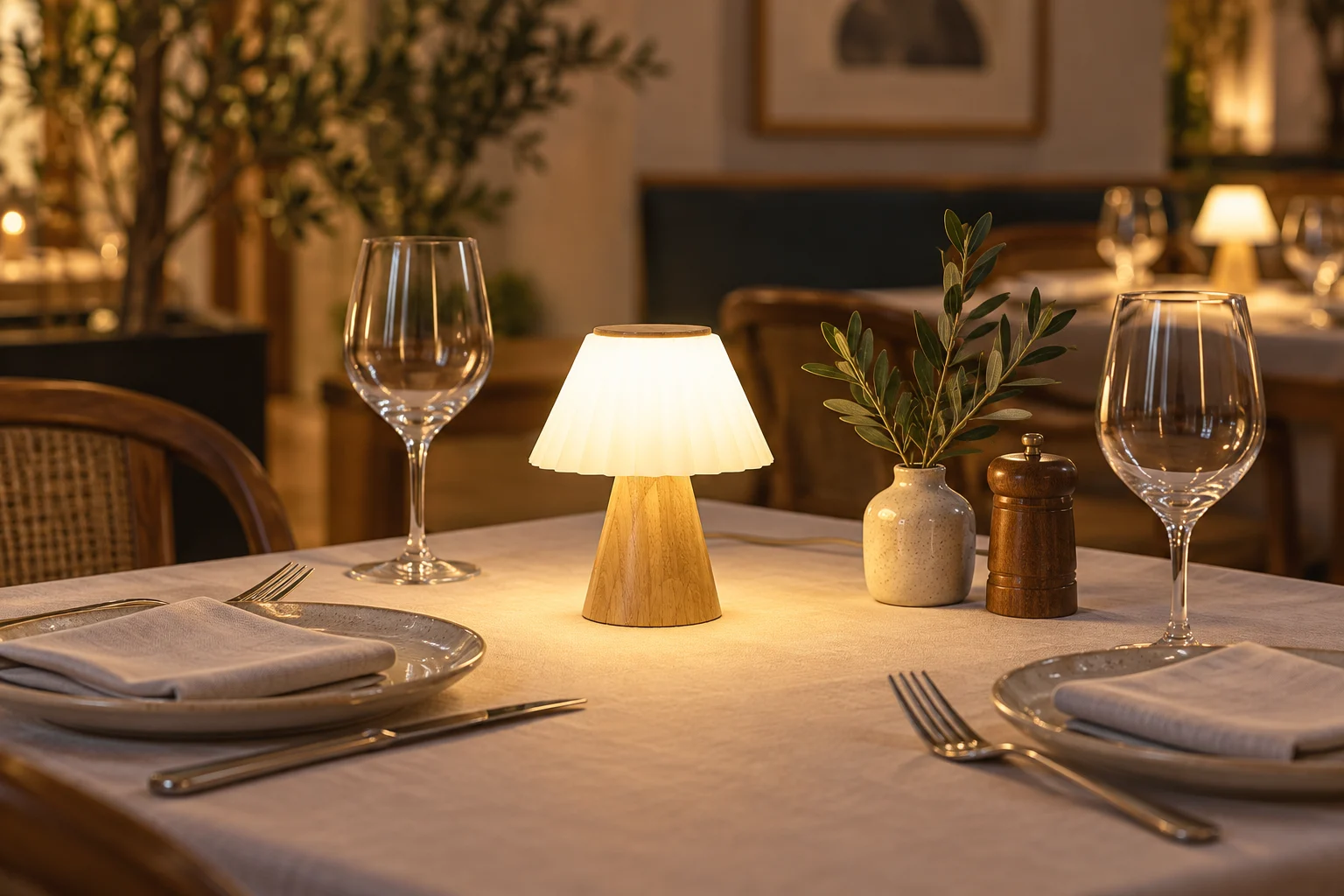
Try the lamp with the full place setting and normal service routine before deciding on a room-wide order.
Set the table before placing the lamp
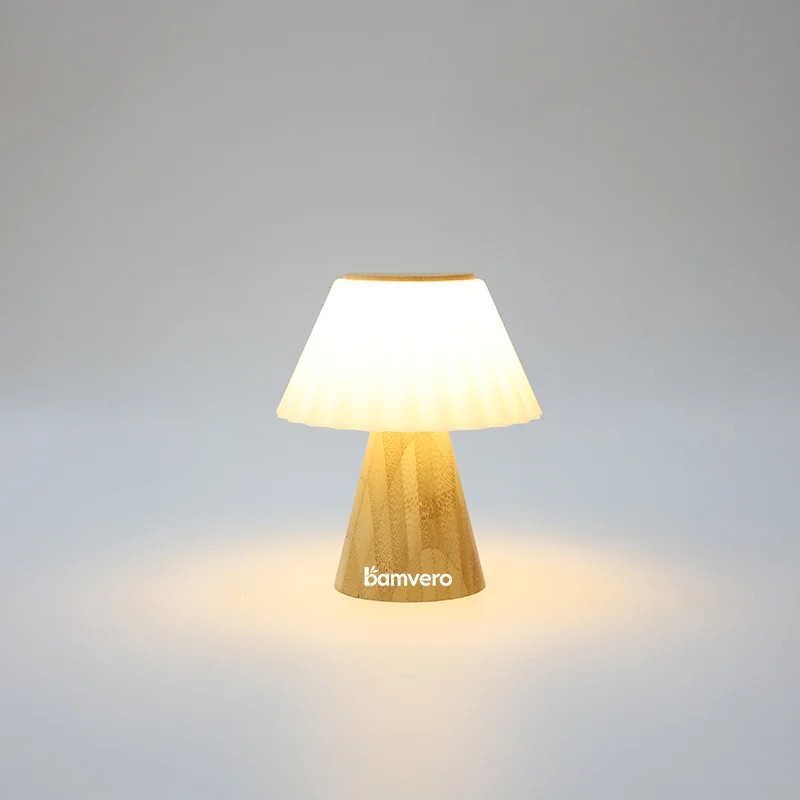
Use the smallest table arrangement that would receive a lamp. Put out the normal plates, glasses, cutlery, menus and any shared items first. Then find a position where the lamp can remain without being moved whenever food arrives. An empty-table photograph is not a realistic space test.
The listed T2631 dimensions are 137 × 162 × 80 mm. Confirm the dimension orientation and actual sample footprint before specifying a layout. Leave enough space around the shade as well as the base; a narrow base does not mean the whole lamp occupies the same small area.
Ask staff to carry out a normal sequence of serving and clearing with the sample in place. Notice whether sleeves, trays or table items catch the lamp or its lead. If a workable position cannot be found, consider a different fixture or location rather than forcing the table arrangement around the product.
Check the view from each seat
Review the lamp while seated, not only while standing above the table. Check whether the shade blocks the view of another diner and whether light is uncomfortable from a lower viewing angle. A position that photographs well may not suit every seat.
Test with the restaurant's usual room lighting. The T2631 is described as an ambient lamp; its product page does not establish reading-light performance or a measured illumination level for menus. Do not treat a warm glow as proof that it can replace the venue's functional lighting.
Where guests need to read printed menus, check that task in the actual conditions and retain appropriate room lighting. Any required lighting assessment should be handled by the venue's responsible professional. The pilot is a practical usability review, not a lighting compliance certificate.
Plan the power route before discussing quantity
The T2631 page specifies a USB-C power interface. That fact alone does not establish battery operation, runtime or the included power adapter. Confirm the input rating, cable requirements and packing list for the quoted configuration before planning where it will sit.
Work with the venue's responsible staff to decide whether there is an appropriate power point and an acceptable cable route. Do not run a loose lead across a guest walkway or improvise an electrical installation to accommodate a decorative object. If the site needs electrical work, have it assessed by a qualified professional.
A venue specifically seeking rechargeable lamps can separately review the T2633 touch table lamp. Do not transfer that model's features to T2631. Battery capacity, useful runtime at the selected setting and the charging routine should be confirmed and evaluated for the exact supplied configuration.
Discuss spills and cleaning before the trial
Dining tables are cleaned frequently and can be exposed to spilled drinks. No waterproof rating or outdoor suitability is established here for T2631. Do not describe it as a washable restaurant fixture or assume it can be used on a terrace because its materials suit the interior style.
Ask the supplier for permitted cleaning methods for the shade and bamboo surface, and compare those methods with the venue's routine. Do not spray or immerse an electrical product as a trial cleaning method. If the required cleaning or spill exposure cannot be supported by the product information, choose another solution.
Agree where lamps will be placed during table cleaning and how staff will handle them. A product that is attractive during service may still be impractical if the shade is repeatedly bumped during clearing or there is no suitable place to store it safely.
Run the pilot across real service conditions
Choose representative tables and include the staff who set, serve and clear them. Review different room-light conditions and the normal range of table settings. Keep a simple record of placement changes, guest-facing glare, handling difficulties and questions about power or cleaning.
Agree in advance what would make the trial unsuccessful. Examples include a lead route that cannot be made suitable, repeated interference with serving space or cleaning requirements that the supplier cannot confirm. This is more useful than deciding only whether the lamp “looks nice.”
Keep the sample and its configuration identified. If a different cable, finish or model is later quoted, revisit the part of the trial affected by that change. A successful trial supports only the setup actually reviewed.
Turn the findings into a focused inquiry
After the trial, share the intended quantity, table dimensions, indoor setting, power arrangement and handling requirements. Add questions about branding or packaging only after the basic operating fit is clear. The product catalogue can help compare alternatives without assuming they all serve the same purpose.
Use the product catalogue request to describe the venue and ask for an appropriate shortlist. Include what did not work in the pilot as well as what did. That gives the supplier a practical brief for the next decision and prevents a room-wide purchase from depending on a single staged photograph.
Planning table lighting for an indoor venue?
Try the lamp with the full place setting and normal service routine before deciding on a room-wide order.
Discuss a table lamp pilot